
Let’s Talk About Breathing…
Were you ever actually taught how to breathe properly? It sounds like a silly question — breathing happens automatically, without you even thinking about it. But how you breathe makes a bigger difference than most people realize. Proper breathing plays a key role in managing pain, calming your nervous system, and activating the deep core muscles that support your body every day.
Here’s something cool: when you take a deep breath, your diaphragm — the dome-shaped muscle just below your lungs — drops downward. This movement stimulates the vagus nerve, which is like your body’s built-in “chill out” switch. It activates what’s called the parasympathetic nervous system, or your “rest and digest” mode, which actually lowers your stress levels. That’s right, a few deep breaths can genuinely calm your body from the inside out.
Your diaphragm is doing a lot more work than most people give it credit for. Yes, it helps you breathe — but it also controls pressure inside your abdomen and acts as a stabilizer for your entire trunk. Think of it like the foundation of a house. When your abdominal muscles are weak, your diaphragm has to pick up the extra work of holding you upright, and it flattens out instead of keeping its natural dome shape. When that happens, your low back and a deep muscle called the psoas have to work overtime to keep you stable — which leads to tension, tightness, and that all-too-familiar low back pain.
Deep, intentional breathing helps release the muscles that tend to get tight around your spine and pelvis. On your inhale, those back muscles lengthen and relax. On your exhale, your core and pelvic floor gently engage and strengthen. Over time, this simple habit can reduce low back pain, relieve SI joint discomfort, and create a stronger, more balanced core.
Have you ever heard of 360 breathing?
This breathing pattern is essential for allowing air to expand into the front, sides, and back of your ribcage — a full 360 degrees.
Most of us are chest breathers without even knowing it. You’ve probably seen it in yourself or someone else: shoulders rising up toward the ears, chest puffing forward, and shallow breaths that never quite feel satisfying. This kind of breathing only uses the top portion of your lungs and keeps your body in a low-grade state of tension.
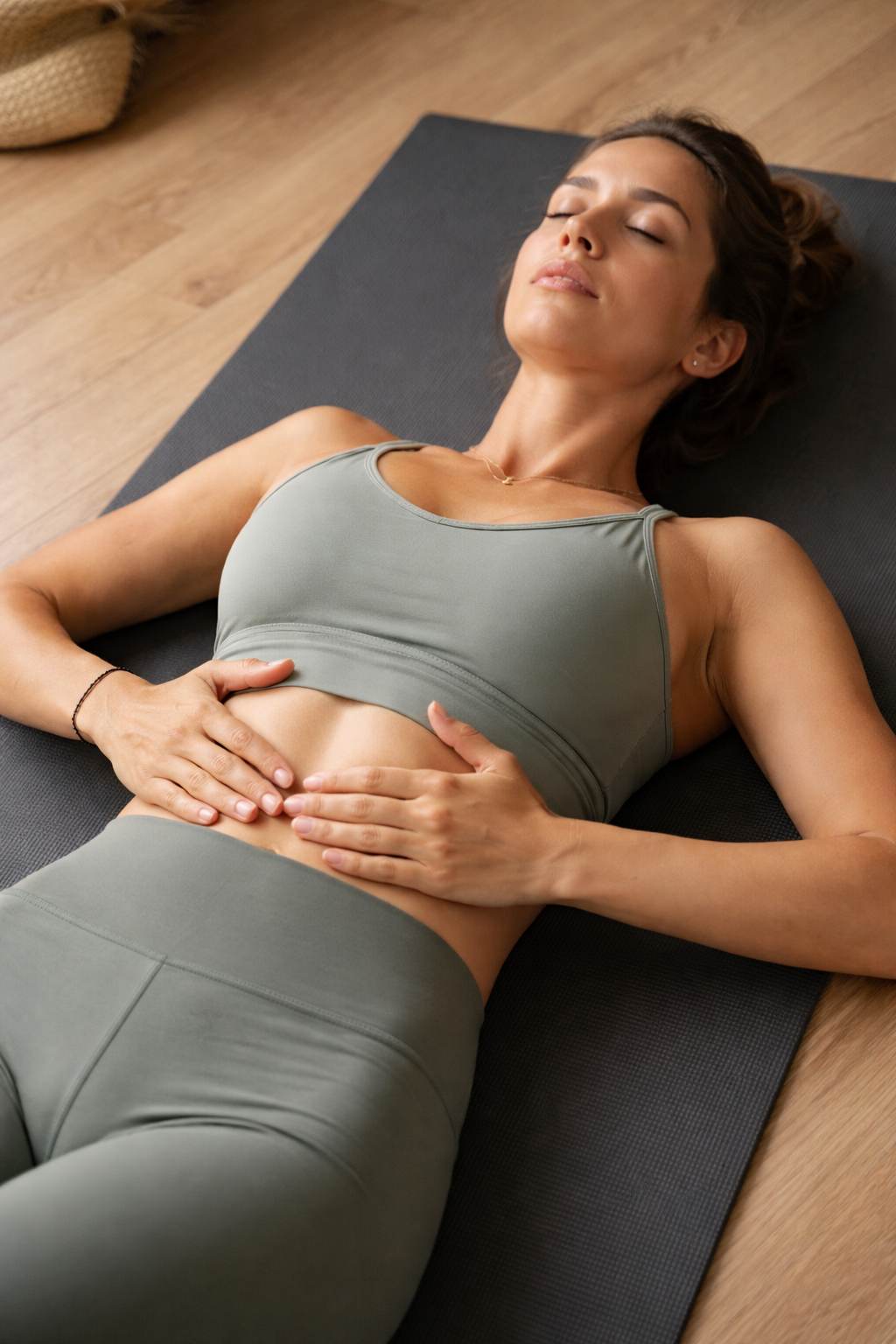
Diaphragmatic breathing changes that. Instead of breathing up, you breathe out — expanding in every direction like a balloon inflating from its center. When done correctly, you should feel your ribcage widen to the sides, your belly gently rise forward, and even your low back expand slightly with each inhale. Your shoulders stay relaxed and still the entire time.
To try it yourself, place both hands on the side of your ribcage. Take a slow breath in through your nose and focus on pushing both hands outward. Hold for a moment, then exhale slowly through your mouth, feeling everything gently draw back in. That’s 360 breathing.
Practicing this pattern — even just five to ten minutes a day — retrains your body to use the diaphragm the way it was designed. The result is less tension, better posture, a calmer nervous system, and a stronger, more supported core from the inside out.
Give this breathing pattern at try at home :)
